The first note in this series has drawn a lot of attention. To quickly recap, I argued that even though Meta’s $20 billion/year VR project is now pretty much dead, and seemingly so is most of the current VR market, the fundamental technology is here to stay. The technology industry may have moved on to AI, but the virtual reality concept is so deeply embedded in human psychology, philosophy, and culture that efforts to realize it through technology will inevitably persist and resurge.
When VR technology becomes mainstream—pervasive, affordable, socially normalized, and supported by rich content ecosystems—we can expect major economic, cultural, and legal disruptive effects. I have written before about innovation through disruption, suggesting that it may lead to problematic imbalances. Widespread adoption of VR technology has the potential to either advance or undermine core social systems and structures. This is something we should be aware of and possibly plan for.
What makes VR fundamentally different, and potentially more disruptive, than other technologies of the Information Age? Some commentators on last week’s note were skeptical that it is. Here is my answer.
Unlike other technologies of the digital age, VR is built to deliver a subjective psychological effect that believably simulates physical reality. It is a psychotechnological means of manipulating perception via false sensory cues—a magic trick.
Human perception is the result of an active mental process: the mind receives cues from various sensory sources and synthesizes them using memory and association to form a consistent internal model of the world. Manipulating this process is a matter of replacing real sensory cues with simulated cues, even rough ones, tricking the mind into creating and maintaining an artificial perception model and the subjective feeling of being present elsewhere. VR technology does exactly that. To emphasize, virtual reality does not need to be indistinguishable from physical reality to be effective, far from it; provide enough sensory cues, and the human mind will do the rest.
Cognitive research shows that the VR effect is powerful enough that users act and interact in ways that mirror real-world social norms and behavior; they consistently apply similar values and moral judgments in virtual and physical reality. In fact, VR is so effective that psychologists use it to influence real-life behavior; it helps rehabilitate offenders and treat phobias.
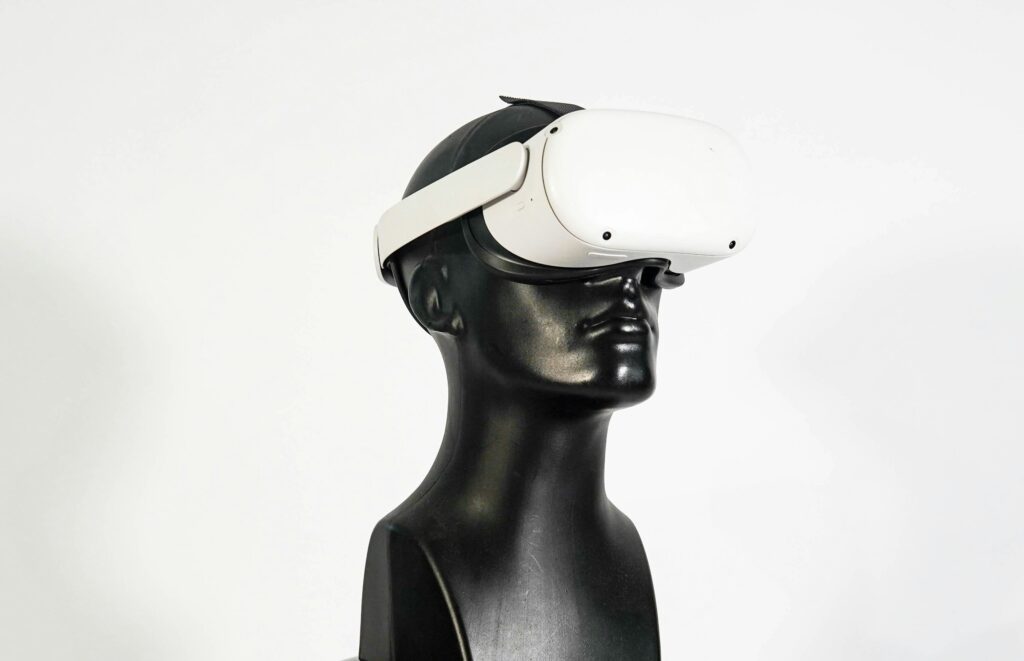
The key psychotechnological element of VR is presence. Presence is something we have all experienced; it is a very natural human experience. The effect of dreaming is similar to that of VR, albeit via a somewhat different mechanism: the mind blocks external stimuli and provides simulated sensory cues to create a sense of Presence in the dream. It is the ability to create Presence, the feeling of being present elsewhere using technology, that makes VR psychologically unique. Other experiences, like playing a video game, watching a movie, or reading this note, can be engaging, bringing about focus and concentration, but they do not create the psychological state of being present in a different place. VR environments provide users’ minds with sufficient sensory cues so that, in that moment, the virtual reality is their only reality.
As I mentioned, Presence has a social aspect. VR users form awareness of others and of being in their company, as well as a perceived ability to assess others and act on that assessment. This awareness leads VR users to behave in ways suggesting that they have imported real-world social conventions and morality into the VR environment. When social and moral dilemma experiments with well-established real-world results are replicated in VR, the results remain consistent. In fact, experimental behavioral studies using VR models are considered a viable research methodology in moral psychology, particularly useful in situations where a real-world study would be impossible to conduct. It is the social aspect of VR technology that has led Meta to invest so heavily in VR research and development.
Presence also has a spatial aspect. VR users gain a specific perception of being physically situated within a geometrical spatial environment. This element of Presence makes VR an effective training platform for spatial tasks, as spatial skills gained in VR carry over extremely well to the real world. Brain imaging studies show that Presence operates at a deep cognitive level, manipulating users’ conscious minds to believe they are actually navigating an alternate spatial reality.
So VR allows us to operate in an alternative social and spatial environment. But aren’t we already operating in such an environment? We are; we call it cyberspace.
We experience cyberspace as a metaphorical social space. We refer to online activity using terms like navigate, visit, or enter; we talk about being in an online room, forum, or lobby. Even mediated through relatively limited means of communication like social media or instant messages, people form intense interpersonal connections, feeling that cyberspace allows them to connect directly with others’ minds, know them, and be known on a deep level. The cyberspace social metaphor is linked to the metaphorical spatial perception of cyberspace, as interpersonal connections are often linked to physical or perceived places.
The concept of cyberspace was preceded and influenced by virtual reality. In 1965, the height of computer technology was the IBM System/360, a room-sized computer that would not match the computing power of a current flash drive microprocessor. That same year, computer scientist Ivan Sutherland published a short paper in which he explained how, one day, computers would be used to create interactive artificial realities. Twenty years passed before the term Cyberspace first appeared in science fiction literature, and even then, it was used to describe a technology that sounds more like VR than the Internet. Until the mid-1990s, Cyberspace and Virtual Reality were still used interchangeably; the current use of Cyberspace as more or less synonymous with the Internet is relatively new.
Philosophers of technology suggest that Cyberspace, like VR, is a concept that involves the human state of being in a space that exists beyond everyday bodily experience, a technological expression of humanity’s desire to break out of the limitations of the physical body and the natural world to a controllable environment with endless potential and possibilities. Both Cyberspace and Virtual Reality are metaphysical concepts that describe an aspiration for a subjective cognitive experience beyond physical reality. The conception of VR advances this aspiration by directly affecting cognition, while the contemporary conception of Cyberspace relies on metaphor. In other words, VR is cyberspace, or rather the next evolution of cyberspace, another step in humanity’s intellectual quest to escape its physical limitations.
VR technology is different and potentially more disruptive than other digital technologies because it could revolutionize the entire online experience. That does not mean that we will always be immersed in a simulated spatial and social virtual environment. The real world is always spatial and social, but real-world human behavior is not. People often engage in activities that do not involve actively moving through navigable space, like reading a book, watching a movie, or just relaxing; they are also sometimes by themselves. Likewise, cyberspace need not fully and continuously simulate the real world, with its social and spatial characteristics, to provide a virtual reality experience; it is enough that it can do so when spatial and social action is required.
Cyberspace is the revolutionary technology of our times, one of the most socially disruptive technologies in the history of humanity. When VR technology becomes mainstream, it will realize the metaphorical vision of cyberspace, creating what we always imagined the online experience to be—a place beyond our physical reality where anything is possible.
2,421 · 5 · Apr. 2, 2026 · Culture, Future, VR · Index
Continue to the last part of this series:
-

VR Amends
Part 3/3: VR technology challenges the core assumptions of Internet laws, presenting an opportunity to amend them.