“I do think it’s worth thinking about whether what you’re doing is going to result in disruptive change or not. If it’s just incremental, it’s unlikely to be something major.”
—Elon Musk
In the technology industry, disruption appears in nearly every technology startup profile. It is not just a buzzword; it is a philosophy that prizes the radical overthrow of established systems over incremental progress; it is the misguided notion, in my view, that for the new to grow, the old must die.
Disruption culture is fueled by a venture capital ecosystem that strongly favors exponential gains over steady growth. Traditional investment banks look for steady, predictable returns. VCs expect 9 out of every 10 investments to fail, provided the 10th investment brings a huge return.
The AI hype has affected how VCs do business, and many are now taking on more risk—funding capital-intensive innovation in fields like energy, biotech, and robotics. They understand that the AI industry requires significant investments in infrastructure and hardware, and that disruptive innovation in these areas can pay off in a big way. They also realize, looking at the impact AI innovation is making, that expanding their investment models to include riskier deep-tech investments, which are more likely to fail but, if they succeed, will cause large-scale disruption, can be financially justified.
The theoretical problem with disruption is that it destabilizes social systems in unpredictable and potentially damaging ways. The deep disruption technology companies now seek exacerbates the problem.
The term disruptive innovation was coined by Clayton M. Christensen in his 1997 book The Innovator’s Dilemma. Christensen classified innovation into three levels.
Evolutionary innovation improves a product in an existing market in a predictable way; for example, a better automobile drive system that is more fuel-efficient, quieter, and produces less pollution.
Revolutionary innovation is unexpected yet remains within the existing market for the product; for example, hybrid automobile drive systems that combine an internal combustion engine with an electric system to produce a technological improvement that is not a natural extension of existing technology and brings marked improvements with regard to fuel efficiency, noise, and pollution.
Disruptive innovation creates a new market with a new set of values. Fully electric cars, which do not use fuel at all, are relatively quiet, do not pollute, and are a technology that creates a new market with a different set of social values. In other words, disruptive innovation affects society, possibly dramatically.

Technological innovation has dramatically transformed society across at least three periods of human history, including the era we live in now. However, the relationship between technology and society is better understood as a reciprocal one. Technological innovation is a powerful driver of social change, but major events—such as economic crises, war, or disease—can also greatly affect society. Such significant events and the social changes they create may, in turn, drive technological development and adoption. Here are three historical examples:
The 1929 Great Depression was the most severe economic crisis in modern history. It drove social change, affecting labor relations, women’s rights, and the roles of community organizations and the government during economic upheaval. It also drove the adoption of the radio broadcasting technology. Radio receivers became a household staple during this time of hardship and isolation as people sought an affordable, accessible way to maintain a sense of community, be entertained, and stay informed.
The Second World War drove multiple social changes, including the strengthening of civil rights movements, the formation of international organizations, and geopolitical shifts such as decolonization. It also introduced innovations that shaped modern aviation, like radar, jet propulsion, and navigation systems; computer technologies in areas such as cryptography and programming; medical innovations, such as the efficient use of antibiotics; and nuclear fission, which led to the harnessing of atomic power.
The 2020 COVID-19 pandemic prompted a significant shift in public health awareness and drove developments in public health infrastructure. It also created a need for remote work and education, driving widespread adoption of video conferencing technologies. This crisis further accelerated the adoption of E-commerce, as lockdowns and social distancing measures led consumers to rely more on online shopping, driving a surge in digital payment methods, innovation in goods delivery, and the expansion of online marketplaces.
There is another way in which major social change can occur. It can be purposely engineered through public policy enacted through laws—conscious acts of governments and legislators.
For instance, in the 19th Century, slavery was abolished in the United States, the United Kingdom, and other countries around the world, starting a worldwide social shift towards racial equality. In the 20th Century, mainly in the 1960s and 1970s, civil rights legislation helped further reduce racial bias and other forms of discrimination. These legal changes reflected the growing public opposition to slavery and the widespread sentiment rejecting social injustice and inequality.
Like technology and society, society and law have a reciprocal relationship—law drives social change, and changing social views drive law.
Like society and technology, and society and law, the connection between technology and law can also be described as reciprocal.
For example, the technological developments that led to the widespread adoption of automobiles in the late 19th and early 20th centuries necessitated driver licensing, safety regulations, and traffic laws. Once such laws were enacted, they influenced the development of automobile technologies. Headlights, brake lights, speedometers, and horns were designed and installed to comply with traffic laws. Seat belts, airbags, and anti-lock braking systems were developed. Right now, legislators are debating autonomous vehicle laws while automakers are working on making the technology safer and more reliable.
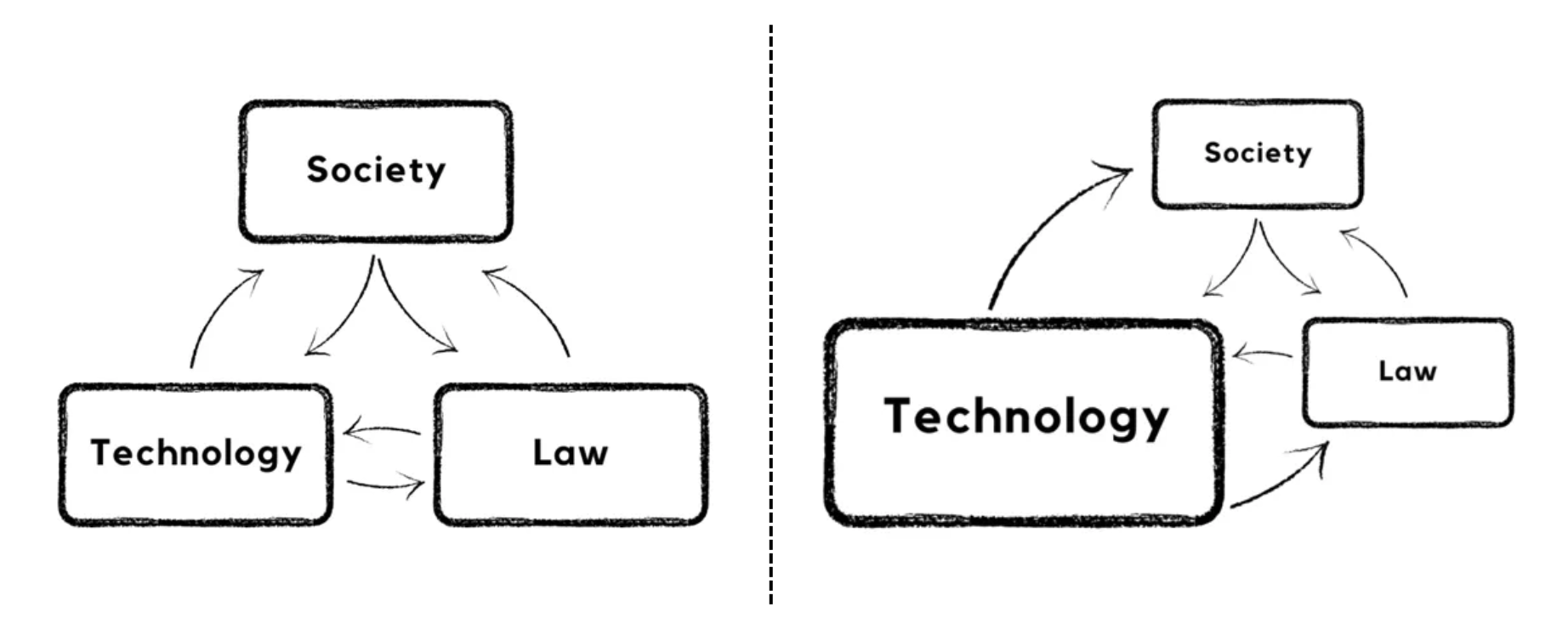
The interconnected relationships between technology and society, society and law, and law and technology create a reciprocal framework of society, technology, and law. When society, technology, and law are in equilibrium, they can optimally support sustainable, stable progress. Technology is developed and deployed in ways that benefit society; society adopts beneficial new technology that enhances social values and structures; and the law regulates technological advancement while safeguarding the public interest. Disruptive innovation, however, is specifically designed to create an imbalance.
When technology takes over, we get giant technology corporations with the wealth and power of nations. They are so strong that they can disregard social values and impose their own agendas. The law becomes too weak in comparison, unable to effectively regulate technology and protect public interests. Just look at the failure to regulate social media and at the current difficulties in regulating AI technology.
The practical consequences of technology disruption can be dire. The Industrial Revolution was a period of great technological innovation that dramatically changed human society. It also produced significant economic upheaval, the circumstances of the Great Depression, and the geopolitical settings of the two World Wars.
We should acknowledge that the notion that worthwhile technological progress should always make a radical impact on existing markets and society is flawed. Disruption should not be viewed as a goal to pursue but rather as a potentially problematic consequence of technological advancement. Growth can be achieved in leaps and bounds; that is the nature of innovation, but major and continuous disruption of the society-technology-law equilibrium, a chronic imbalance between society, technology, and law, is something we should strive to avoid, not pursue.
105 · 2 · Jan. 16, 2026 · Future, Markets, Policy · Index
Continue to this week’s featured note:
-

Magic Swords
Vikings, magic swords, and why technology should be as easy to understand as it is easy to use.