So, a lawyer, an AI, and a monkey walk into a bar. The lawyer looks around and asks, “Wait, is this a lawyer joke?” The AI says, “Statistically speaking, it isn’t a monkey joke.” And then the monkey says… Well, I’ll tell you what the monkey says in a little bit.
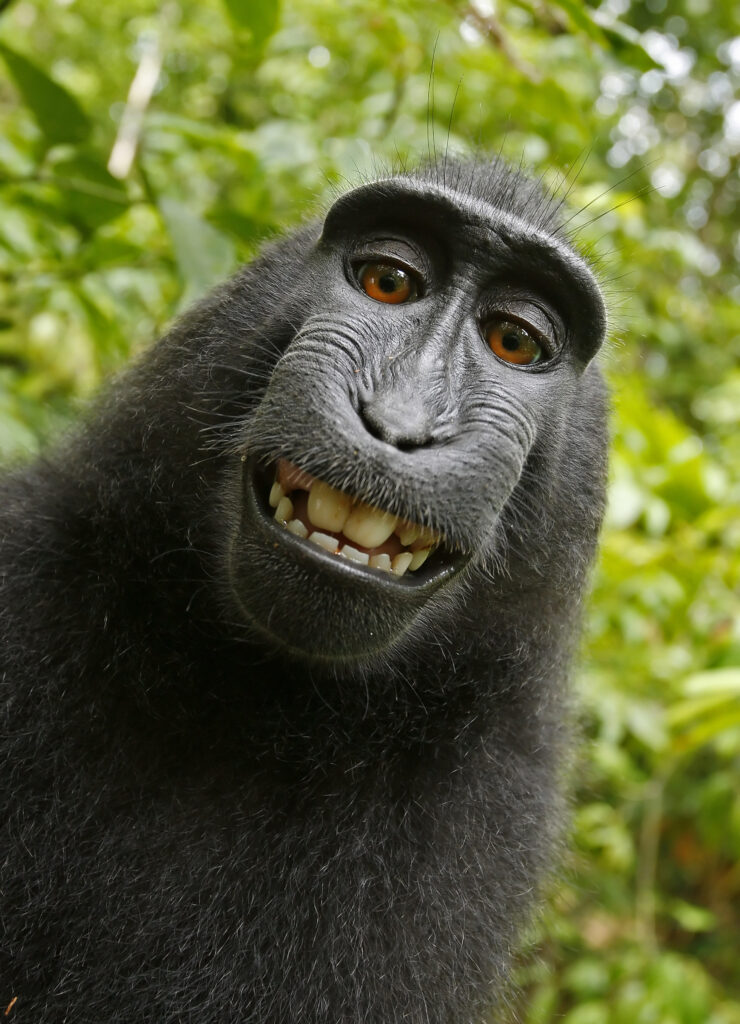
In July 2011, several newspapers, including The Telegraph and The Guardian, published the picture you see above along with a story explaining it was a selfie taken by the monkey itself. As it turns out, British wildlife photographer David J. Slater was taking photographs in Indonesia of crested black macaques when the monkeys, playing with the camera gear, took several photos of themselves.
A few days after these publications, an editor on Wikimedia Commons uploaded the selfie photographs to the site. Slater requested the removal of the photos, claiming copyright infringement. They were first removed, but after a discussion and further correspondence with Slater, Wikimedia restored the photographs, stating that, as they were not taken by a legal person capable of holding a copyright, they were in the public domain. Consequently, other Internet sites published the photos. Slater continued to claim copyright in the photos, saying he made significant creative contributions by setting up the equipment and the photography environment. The dispute got considerable media attention.
Matters got more complicated when, in 2015, People for the Ethical Treatment of Animals (PETA) filed a lawsuit against Slater, on behalf of the monkey, which they named Naruto, requesting that the monkey be assigned copyright. Additionally, PETA asked the court to be appointed to administer the proceeds from the photos for the benefit of Naruto and other crested macaques. In 2018, following several legal proceedings in the US District Court for the Northern District of California and in the Ninth Circuit Court of Appeals, the court ruled in favor of Slater, finding that animals have no legal authority to hold copyright claims. The court also criticized PETA, expressing concern that its actions during the case were aligned with promoting its own interests rather than protecting Naruto and his pals.
As we are at the peak of the AI hype cycle, the obvious takeaway from the monkey selfie case and the ruling asserting that non-humans cannot hold a copyright is that purely AI-generated content cannot be copyrighted. This was recently affirmed, specifically with regard to AI, by the U.S. Court of Appeals for the D.C. Circuit in Thaler v. Perlmutter. To complete the picture, the US Copyright Office, in a 2025 report, determined that prompting is not authoring for the purpose of copyright:
“The Office concludes that, given current generally available technology, prompts alone do not provide sufficient human control to make users of an AI system the authors of the output. Prompts essentially function as instructions that convey unprotectible ideas. While highly detailed prompts could contain the user’s desired expressive elements, at present they do not control how the AI system processes them in generating the output.”
That’s right. You do not legally own that image you generated for your social media profile, no matter how original, creative, and complex the prompt was. For an AI-generated image to be copyrightable, there needs to be substantial human involvement in its creation. If, for example, you add your own original effort by manually editing or modifying the generated image, adding a meaningful contribution to the work, then that picture may be copyrightable.
The same goes for AI-generated text. There must be meaningful human authorship added to the work, making it AI-assisted rather than AI-generated, for it to be copyrightable. As the Copyright Office report explains, quoting previous reports:
“Generating content with AI is often an initial or intermediate step, and human authorship may be added in the final product…a human may select or arrange AI-generated material in a sufficiently creative way that ‘the resulting work as a whole constitutes an original work of authorship.’ A human may also ‘modify material originally generated by AI technology to such a degree that the modifications meet the standard for copyright protection.’”
Of course, this doesn’t mean you can’t use your purely AI-generated content as is; it just means it isn’t legally protected if someone else uses it. There is more to say about which parts and types of content can and cannot be protected and under what circumstances, but we don’t need to get into that right now.
Modern copyright originated in the 15th century as a response to the printing press, which enabled rapid, inexpensive reproduction of written material. Over the following centuries, copyright expanded through national laws and international treaties such as the TRIPS Agreement, standardizing protections across jurisdictions and adapting to new media like video, software, and digital content.
Copyright grants creators exclusive rights to reproduce, distribute, adapt, and publicly perform their works, enabling them to control how their creations are used and monetized. The protection is applied automatically to original works of human authorship that are fixed in a tangible medium, and does not require official registration. Copyright provides the legal framework for entire industries—music, film, software, publishing, and digital media, through licensing and enforcement. In the information age, it is a critical economic mechanism.
Now, because purely AI-generated work cannot be copyrighted, millions of new images, articles, software applications, and videos are entering the public domain every day. Many more, those that involve some measure of human authorship, are created in a state of legal uncertainty, perhaps copyrightable and perhaps not. It is often difficult, and getting more difficult every day, to tell whether a creative work is fully AI-generated, partly AI-generated, or created by a human. We are moving from a world of default creative ownership to one where most things are generated, unowned, and free by default.
If freely available AI content competes with human-created, copyrighted works, it can reduce demand for original creative content, disrupting revenue streams for authors, artists, and creators who rely on copyright protection for income. This could affect licensing deals, publishing standards, and incentives to produce high-quality content. As AI-generated content evolves, norms about what counts as valuable or original creative content may shift, potentially weakening the practical impact of copyright. Creative industries that rely on copyright could come under significant pressure or even collapse entirely. The result is a world with fewer creators and less original creativity.
So, a lawyer, an AI, and a monkey walk into a bar. The lawyer looks around and asks, “Wait, is this a lawyer joke?” The AI says, “Statistically speaking, it isn’t a monkey joke.” And then the monkey says nothing. Monkeys can’t talk. Did you expect something more creative? Get used to it. This joke was written by AI.
162 · 2 · Jan. 25, 2026 · AI, Policy · Index
Continue to this week’s featured note:
-

Magic Swords
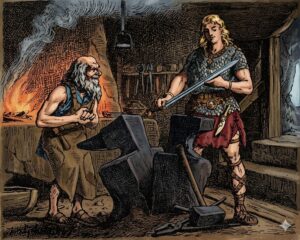
Vikings, magic swords, and why technology should be as easy to understand as it is easy to use.