“O, it is excellent To have a giant’s strength, but it is tyrannous To use it like a giant.”
—William Shakespeare, Measure for Measure
In the previous part (Great Expectations), we looked at the 1990s cyber-utopian conceptions of the Information Revolution. For a while, it seemed like the Internet would usher in an era of freedom, equality, and democracy, leading to world peace and global prosperity. These optimistic predictions, reminiscent of the utopian future society depicted in Star Trek, seem naive now.
There is one major thing that cyber-utopians failed to predict. They did not foresee that thirty years after the onset of the Information Revolution, the technology market would be dominated by only a handful of mega-corporations—The Magnificent Seven, as termed by CNBC’s Jim Cramer. Each of these top technology giants—Apple, Nvidia, Microsoft, Alphabet, Amazon, Meta, and Tesla—has achieved monopolistic control over one or more fundamental technology markets. They have done so through entrepreneurship, innovation, and creativity, but also by abusing monopolistic power, adopting aggressive business practices, and blatantly disregarding the rights of their billions of users. These mega-corporations now drive the Information Revolution, defining its path and future.
For most of the last decade, Apple has been the world’s largest company by market capitalization. Its core business is high-end smartphones, tablets, computers, accessories, and related services. Around 60% of smartphones sold in the United States are Apple iPhones.
Nvidia mainly designs and manufactures specialized graphics and artificial intelligence processing units. In these markets, the company’s products hold around 90% share. Nvidia has experienced exponential growth in recent years due to the accelerated development of artificial intelligence technologies.
Microsoft operating systems run on 70% of computers worldwide.
Google’s parent company, Alphabet, dominates multiple global technology markets with products and services like Google Search, Gmail, Google Maps, Chrome, Android, and YouTube—each holding close to or more than 70% share in their respective markets. Alphabet is also the world’s largest digital advertising company, holding roughly 25% of the global digital advertising market and 80% of the pay-to-click ad market.
Amazon leads the electronic commerce market with approximately 40% of this huge market in the United States, which translates to $1.2 billion in U.S. sales every day. It also dominates the cloud infrastructure business; Amazon Web Services holds 30% of the global cloud infrastructure market.
More than 3.3 billion people actively use at least one of Meta’s social networks—Facebook, Instagram, WhatsApp, and Messenger. That is more than 40% of the world’s total population, but the relevant figure is much higher, around 90%, after discounting young children and people without any access to the Internet.
Tesla develops high-end connected electric vehicles with autonomous driving and other advanced technological features. It holds close to half of the United States electric vehicle market.
In 2020, the House Judiciary Subcommittee on Antitrust, Commercial, and Administrative Law of the United States Congress published the results of a detailed investigation into major technology companies, focusing on Google, Facebook, Apple, and Amazon. The investigation determined that each platform has achieved monopoly-like market dominance in key areas of the Information Revolution. These companies act as gatekeepers, controlling access to digital markets and using this control to suppress competition. Google, for example, used its search engine dominance to promote its services while down-ranking competitors, Amazon prioritized its own brands, and Apple imposed limits on rivals in its App Store. Facebook acquired Instagram and WhatsApp to eliminate potential competitors. These anti-competitive practices stifled innovation, limited user choice, and raised prices. Similar findings in the European Union led to the enactment of anti-trust legislation in digital markets, which is currently being contested by technology companies. However, legislation and regulation efforts have a limited effect on these mega-corporations—they are just too big and too powerful.
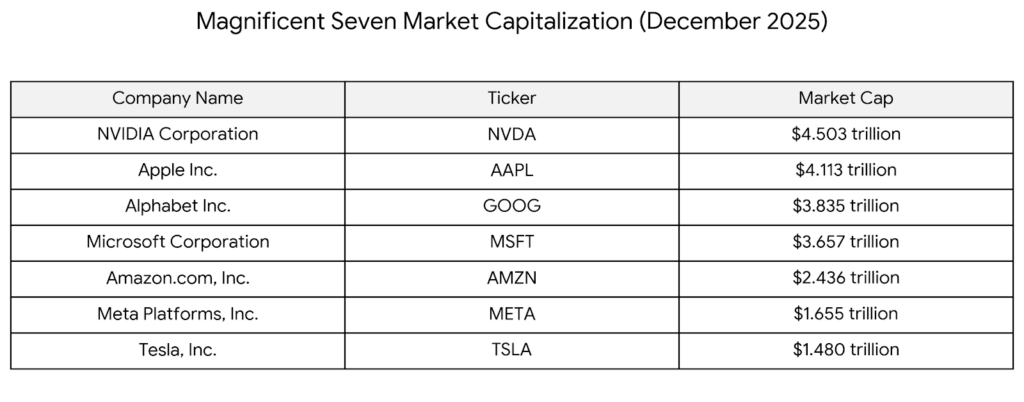
Each of the Magnificent Seven is worth more than $1 trillion, together they make up more than a third of the S&P 500. This level of wealth concentration in a single sector of just a few companies is unprecedented. Apple alone made $416 billion in revenues in the 2025 fiscal year, which is approximately the gross domestic product of Denmark. In other words, Apple, a single company, generates economic activity like a midsize European country. If the top seven technology giants, with aggregate annual revenues of over $2 trillion, were a national economy, they would rank among the top 15 economies in the world, comparable to nations like Russia, Canada, or Brazil.
Technology giants have not only amassed nation-level economic power; they have attained incredible influence over the daily lives of billions of people. All of us have become dependent on technology like never before. A dropped iPhone is a personal crisis; a 45-minute Facebook service outage is a headline on the evening news; a minor YouTube interface redesign enrages millions. Besides direct influence through popular services that have become essential for many, technology companies exert political influence by leveraging their immense wealth to lobby for their business interests with government officials and politicians. They spend millions and employ hundreds of lobbyists.
In 2020, the Australian government began drafting a law to compel online platforms to pay news providers for their content. The proposed legislation faced strong opposition from Facebook and Google, which were concerned that an Australian precedent would encourage other countries and other content providers to follow suit and force them to pay for content, undermining both companies’ business models. Google Australia director Mel Silva said the proposed law was “unworkable” and that the company would discontinue access to its search engine in Australia if it were enacted. Facebook made similar threats, stating that the proposed law “lets publishers charge us for as much content as they want at a price with no clear limits.”
On 17 February 2021, Facebook followed through on its threats and blocked all news from being seen or shared by Australian users and all Australian news from being shared by anyone on their social network. This ban included numerous Australian government and community pages, including those of health agencies and emergency services, amid the COVID-19 pandemic. In response, Australian Prime Minister Scott Morrison said the following:
“Facebook’s actions to unfriend Australia today, cutting off essential information services on health and emergency services, were as arrogant as they were disappointing. These actions will only confirm the concerns that an increasing number of countries are expressing about the behaviour of Big Tech companies who think they are bigger than governments and that the rules should not apply to them.”
The Australian government further said that these actions demonstrated the “immense market power of these digital social giants” and announced it is stopping all advertising on Facebook. However, about a week following this escalation, the Australians negotiated and reached an agreement with Facebook and Google. The legislation was amended to give technology companies greater flexibility in negotiating with publishers. Facebook lifted the news ban. Facebook and Google started paying some media publishers for their content.
In 2023, Canada passed a similar law requiring online platforms to pay Canadian news publishers for their content. Google said the law “exposes us to uncapped financial liability simply for facilitating access to news from Canadian publications” and threatened to no longer make news content available to Canadian users on their platform. Facebook (now Meta) took a firmer stance again in July 2023 and banned Canadian users from accessing news content on its platforms—Facebook, Instagram, and Threads. Canadian Prime Minister Justin Trudeau responded:
“The fact that these internet giants would rather cut off Canadians’ access to local news than pay their fair share is a real problem, and now they’re resorting to bullying tactics to try and get their way. It’s not going to work.”
The Canadian government further demanded that Meta lift the news ban to ensure vital safety information reaches Canadians in regions affected by wildfires.
After negotiations, Google reached an agreement to compensate Canadian news publishers. Meta, however, continues to maintain the ban on news content in Canada. Furthermore, Meta has begun to scale back news content globally. In early 2024, Meta also stopped paying news content providers in Australia.

The open conflict between Meta and Google and two large Western nations, and Meta’s willingness to take aggressive action against governments, demonstrate how powerful technology giants have become. Their power stems from their immense wealth, their vast user base that depends on their services, and their control over the flow of information. Moreover, they have demonstrated a willingness to use their power to advance their business interests, even when that means confronting entire countries. They have become major global geopolitical players at the level of nations, evoking dystopian visions of a world run by giant, power-hungry corporations. A human society straight out of Blade Runner or a Richard K. Morgan novel stands as the antithesis of a cyber-utopia.
64 · 1 · Dec. 10, 2025 · Markets · Index
Continue to the next part of this series:
-

Tech Oligarchs
Part 4/7: The rise of Silicon Sultans, the information age reincarnation of the robber barons of the Industrial Revolution.