
“I think the high-tech industry is used to developing new things very quickly. It’s the Silicon Valley way of doing business: You either move very quickly and you work hard to improve your product technology, or you get destroyed by some other company.”
—Elon Musk
Western society is obsessed with the new. Our cultural and economic systems reward novelty, which is considered synonymous with progress. Unlike some Eastern cultures, the Western conception of time is purely linear. Time moves ever forward, and the future is always an improvement on the past; it brings opportunity, freshness, growth, and success.
Capitalism depends on growth, and companies grow by developing and releasing new and updated products. They tell us that our old products, even if they function perfectly well, should be replaced because they—and by extension, we—are behind, outdated, and out of style.
Digital media amplifies this message. Platforms prioritize what is recent; timelines constantly refresh, news cycles turn over quickly, and algorithms promote what is currently trending. Older content disappears, creating the sense that what matters is what just happened; the rest is irrelevant.
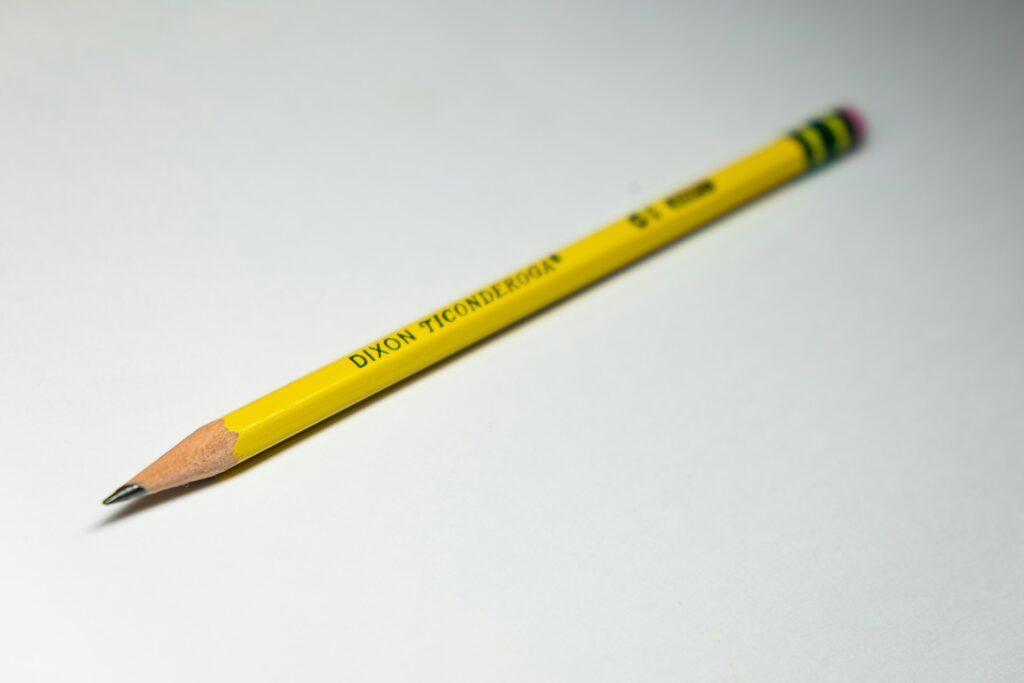
Most of us do not see many pencils anymore; writing notes by hand has been mostly replaced by typing on keyboards and touchscreens. You can do a lot more with an iPad than with a pencil and a piece of paper. But you should not underestimate the pencil.
Pencils have been around for 400 years and are still being made today. They are tools embodying simple, highly specialized technology, adapted to writing, and very efficient for their specific purpose. Pencils are very cost-effective; the graphite in a 10-cent pencil will last for, more or less, one hundred pages of text. It is very easy to carry a pencil; it will not require charging, just a little sharpening, and will never crash, stall, malfunction, behave unpredictably, or shut down unexpectedly. If a pencil breaks, it is very easy to replace. It will work in most environments, unfazed by moisture, dust, heat, or direct sunlight. A pencil is always on; it makes no noise and does not overheat. There is no closed pencil ecosystem; they are compatible with every kind of paper. Pencils are completely safe from viruses, scammers, and hackers; they will never track or manipulate you. An iPad can certainly do a lot more than a pencil. It is much more complex and advanced, but is it a better technology product than a pencil, a simple technology that has persisted through both the Industrial Revolution and the Information Revolution? Not necessarily. One thing is certain—a pencil is good technology.
By the way, so is a book. Douglas Adams said it best:
“Look at a book. A book is the right size to be a book. They’re solar-powered. If you drop them, they keep on being a book. You can find your place in microseconds. Books are really good at being books and no matter what happens books will survive”
Most new technology fails. The failure rate for technology startups is 90%. The failure rate for technology products is much higher because many tech startups develop and launch more than one product before they fail, and because most of the startups considered successes were, at some point, acquired and integrated into bigger companies, along with their technology.
Even an incredibly successful company like Google has shut down more than 300 different products. Many still remember fondly, or less fondly, products like the social network Google+, Google Reader, the Gmail alternative Inbox by Google, Picasa, Orkut, Wave, or Google Glass.
Some failed technology products were useful for a while before changing market conditions or other factors ended their lives; many others were never any good.
It is sometimes hard to understand why someone would want to use new technology that is very likely to fail. However, according to technology marketers, around 15% of the population are technology early adopters—a term coined by researchers in the 1960s. You can find them camping outside the Apple Store on the day of a new iPhone release. They were the first to wear an Oura ring, the first to open a Bluesky account, the first to get a Segway, and the first to own an NFT.
Early adopters pay full price for their technology. They suffer the bugs, defects, and vulnerabilities that come with new technology, acting as paying beta testers for the product. Their new products often suffer from compatibility problems, a lack of content, and poor support. As I mentioned, most of them are doomed to fail, leaving early adopters with an expensive, useless piece of technology.
Why do they do it? Probably because they are risk-takers who enjoy the perceived status and prestige that come with being first. Technology companies benefit from early adoption and encourage it, sometimes offering early adopters benefits or exclusive access to new products.
The status and prestige that early adopters think they gain by rushing to buy new technology is an illusion, based on a misguided social notion that new is always better. Good technology is technology that has persisted—technology that has withstood the test of time. It doesn’t have to be 400 years old like the pencil, but it needs to be something that has been useful for a while.
Not only are most new technology products technologically bad, but some of them may also turn out to be bad for society.
There is an ongoing debate among philosophers of technology about the Neutrality Thesis—the argument that technology is morally neutral.Some contend that technology is a tool, and tools are supposedly neutral. A knife, for example, can be used to murder, prevent murder, or make a salad. Gun advocates use a similar argument; the National Rifle Association of America (NRA) popularized the slogan “Guns don’t kill people, people kill people” in the second half of the 20th Century. Their obvious objective was to shift responsibility for possible wrongdoing from gunmakers, gun distributors, and legislators to gun users, undermining the rationale behind gun control laws.
However, tools are usually not neutral; their design and deployment oftentimes embody or imply moral values. There is a difference between a kitchen knife and a combat knife. There is also a difference between putting firearms in the hands of trained, licensed, and supervised law enforcement officers and allowing anyone to carry a firearm without any oversight. Likewise, technology is not neutral. New technology designed or deployed in a way that causes harm cannot be considered good technology.
For example, tobacco companies market e-cigarettes as a new technology that is socially good because it doesn’t contain as many harmful chemicals as traditional cigarettes. However, as bad as cigarettes are to public health, e-cigarettes may actually be worse, as they are still harmful, addictive products, but now with a much broader appeal, especially to young people. Tobacco products are bad for public health; a new tobacco technology that is still bad for public health cannot be considered socially good technology.
Early adopters usually cannot tell whether they are buying a technology product that will turn out to be good, technologically bad, or socially bad. Google Glass is an excellent example.
In 2012, Google announced smart glasses equipped with a camera and a wireless connection that display information to the user via a heads-up display. Early adopters, whom Google called Glass Explorers, were offered a pre-order version of the product for $1,500. Tens of thousands of devices were sold. At first, Google Glass early adopters were happy and excited. That quickly changed. Many people considered wearing the glasses in public, with their integral video cameras, pretentious, intrusive, and creepy. Google Glass users were dubbed Glassholes; bars and restaurants announced a no-Glass policy; some users were attacked on the street. The product was discontinued in 2013, leaving early adopters with a pair of socially and technologically unusable $1,500 glasses.
The lessons here are clear. New technology is, more often than not, bad technology. Good technology is technology that has withstood the test of time. When it comes to technology, as with most things, patience pays off. Don’t be a Glasshole.
56 | 2 | Published: Jan. 12, 2026 | Updated: Mar. 9, 2026 | Topics: Future, Privacy | Follow
continue to this week’s featured note:
-
Unforgettable
AI technology is making the right to be forgotten obsolete, leaving us prisoners of our own pasts.
Leave a Response