
“In a revolution, as in a novel, the most difficult part to write is the end.”
—Alexis de Tocqueville
Twelve thousand years ago, the Earth was a cooler, greener planet. Woolly mammoths and saber-tooth tigers still roamed the plains, alongside no more than several million early humans. These people, our ancestors, lived in small tribes as hunter-gatherers. Hunter-gatherer societies are exclusively dependent on foraging the local flora, fishing, and hunting wildlife for sustenance. They are nomads, constantly on the move, driven by the changing seasons, plant growth cycles, and animal migration patterns.
Then something changed. Definite archaeological evidence dated around 9000 BCE from the Fertile Crescent, a region spanning modern-day Iraq, Syria, and Israel, shows the cultivation of crops. Humans began to develop farming, recognizing that, with the right tools and techniques, growing crops and raising animals is considerably more efficient than foraging and hunting. This change was made possible only by the development of technologies for plowing, irrigation, food storage, and animal domestication. This shift, from hunting and foraging to agriculture, marked the first great technological revolution in human history.
The Agricultural Revolution was a monumental turning point for our society. Agriculture involves land development and fixed infrastructure, such as fences, water systems, and buildings. A nomadic existence is no longer required or feasible. As hunter-gatherer tribes transitioned into farming communities, nomads became settlers. This change allowed for greater resources, larger populations, the development of trade, and the emergence of more complex social structures. The need for record-keeping led to the development of notation systems that laid the foundation for writing. Perhaps most importantly, the Agricultural Revolution brought about a dramatic change in perception as an inherently short-term nomadic way of thinking gave way to the long-term planning required of farmers and settlers.
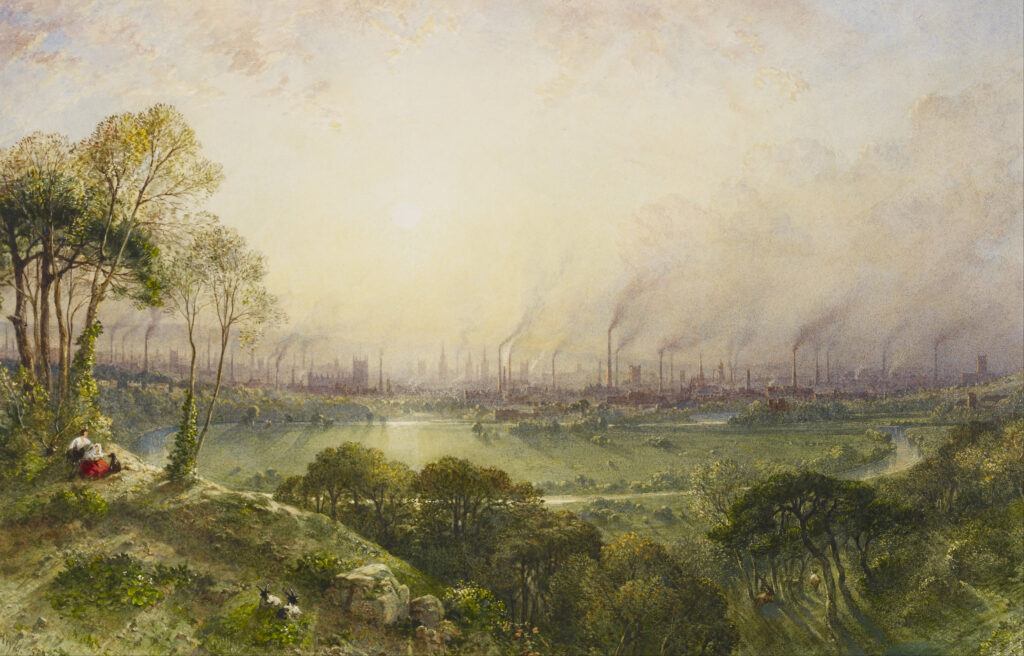
In the late 18th Century, a second great technological revolution began in Britain. Innovations like the steam engine, the mechanized loom, railways, the telegraph, and advances in metallurgy, mining, and chemical processes brought about another dramatic change in human society. Manual labor gave way to machinery, and factories replaced traditional production based on handcrafted goods. Factories centralized manufacturing, allowing for better organization, specialization, and work discipline. The introduction of assembly lines facilitated the efficient mass production of goods, which became standardized, affordable, and accessible. This was the Industrial Revolution.
An agrarian society is characterized by low population density and widespread dispersal because fields and pastures occupy large areas. Factories, on the other hand, gather many workers in relatively small spaces. Moreover, factories tend to cluster near transportation hubs, such as railways, roads, and ports, or near natural resources, such as mines, forests, and rivers. This concentrated industrial activity drew workers from largely impoverished rural areas seeking steadier employment; their families followed. Towns became cities, and cities grew rapidly. Before the Industrial Revolution, roughly one in five people in Britain lived in an urban area; by the late 19th Century, more than two-thirds of the British population lived in cities. Industrialization and urbanization quickly spread from Britain to Europe and most of the world.
Thousands of years after the Agricultural Revolution, the massive urbanization that characterized the Industrial Revolution transformed human society once more. Cities became hubs of economic, cultural, and social activity, driving the development and growth of commerce, financial institutions, cultural exchange, education, government, and law. Urbanization shifted economic and political power from rural estates to industrial cities, eroding the power of aristocratic landowners in favor of a new, prosperous middle class of industrialists, professionals, managers, and merchants. This advanced the development and propagation of modern democracy—government by the people, through publicly elected representatives.
In the 1990s, a third great technological revolution began in the western United States. Advancements in semiconductors, microprocessors, networking, and software drove the development of affordable computers, network infrastructure, data storage, and data processing. The fundamental technology of the Information Revolution is the Internet—a global information network. Within a decade, the development of smartphones and connected devices gave us the ability to access the Internet anywhere, and social networks provided a common infrastructure for human connection, communication, and cooperation. Newer related technologies have emerged: virtual reality, blockchain infrastructure, robotics, and, most notably, autonomous systems and generative artificial intelligence.
Billions use the Internet every day—in kindergartens and nursing homes; in North America and Africa; in offices, homes, and streets. We carry it in our pockets and take it wherever we go. It has become an inseparable extension of our physical reality. Social terms such as community, contact, influence, and friend have changed in meaning. Many people have thousands of online friends, most of whom they have never met in person and likely never will. Many more seek information, advice, and companionship from online chatbots powered by large language models. Autonomous features are now mainstream in cars and home appliances.
The Agricultural Revolution was fueled by technological innovation that allowed for a vastly more efficient use of plant and animal food sources. The Industrial Revolution was driven by technological innovation that enabled vastly more efficient use of natural resources for manufacturing goods. This third great technological revolution, the Information Revolution, is fueled by technological innovation that allows for vastly more efficient use of intellectual resources—knowledge, creativity, and information. The Agricultural Revolution marked a monumental shift from nomadic existence to life in settlements. The Industrial Revolution moved humanity from rural settlements to cities. The Information Revolution likewise brings radical social change. But does it bring social progress? The technology industry is trying to convince us that their products are making our lives better, that they are moving humanity toward the science fiction technological utopia of Gene Roddenberry’s Star Trek, Iain M. Banks’s Culture, or Neal Asher’s Polity—a free, prosperous, egalitarian society. But are they? Serious concerns about the direction of the Information Revolution are mounting. The current techno-social reality is far from utopian. We may soon find ourselves living in a society that looks less like Star Trek and more like Blade Runner.
133 | 2 | Published: Dec. 1, 2025 | Updated: Mar. 30, 2026 | Topics: Culture, Future | Follow
Next in this series:
-

Great Expectations
Part 2/7: Understanding cyber-utopianism, the foundational ideology of the 1990s Internet.
Leave a Response