“Tomorrow, and tomorrow, and tomorrow, creeps in this petty pace from day to day, to the last syllable of recorded time; and all our yesterdays have lighted fools the way to dusty death.”
—William Shakespeare, Macbeth
This is the final part of the Foundation series of essays. Here is a quick recap: Silicon Dawn introduced the series, examining the Information Revolution as a historical process. In Great Expectations, we explored the early visions of an information age utopia. The next two parts, Giants Rise and Tech Oligarchs, focused on the rise of technology mega-corporations and tycoons. Finally, in Filtered Information and Broken Dreams, we saw how the concentration of power in these companies’ hands has shattered the utopian dreams of a free, prosperous, democratic, and peaceful society.
When utopian dreams are shattered, dystopian nightmares emerge. Literature scholarship considers dystopia a literary device used to advocate for social change. Speculative fiction constructs dystopian settings to explore and critique real-world political, social, or technological trends; exaggerating current risks exposes them and provokes reflection. In other words, dystopian fiction is a warning and a call to action.
In 1984, George Orwell depicts a society defined by totalitarian power, political repression, pervasive surveillance, and the systematic manipulation of truth and language, drawing clear inspiration from Nazi Germany and Stalinist Soviet authoritarianism. Ray Bradbury’s Fahrenheit 451 is set in a society that suppresses books, critical thought, and meaningful discourse in favor of shallow entertainment and conformity, critiquing anti-intellectualism, mass media manipulation, and censorship in 20th-century society. In Blade Runner (based on Philip K. Dick’s Do Androids Dream of Electric Sheep?), and also in the Alien franchise, Ridley Scott portrays a future dominated by powerful corporations and class divisions, highlighting the ethical and social consequences of unchecked capitalism, consumerism, and technological exploitation. Tracing its origins to the 16th century, dystopian literature has seen a recent resurgence, perhaps fueled by growing global pessimism. Some of its warnings seem especially relevant.
Imagine a society dominated by massive technology companies that control almost every aspect of life. People have replaced human connection with constant interaction with screens, apps, and devices, which shape their choices in ways that few understand. Social media platforms manipulate attention and opinion, promoting content that maximizes engagement rather than truth or well-being. Algorithms decide what people see, what they buy, and even how they feel, creating a feedback loop where behavior is monitored, predicted, and guided. Politicians exploit these systems to twist public opinion, creating polarization and conflict. Many have lost faith in democracy. Privacy barely exists; data about every action, preference, and interaction is collected, analyzed, and sold. Wealth and power are concentrated in the hands of corporations and their executives, which shape economies and cultures. Society is connected but highly unequal. People communicate constantly, yet meaningful understanding and independent thought are rare. Freedom is nominal; autonomy is limited by the systems and networks that monitor, influence, and reward behavior.
This description of human society in the 3rd decade of the 21st century sounds like something out of dystopian fiction. Still, dystopia implies total loss of agency; we are not there yet. Despite the evident dystopian features of contemporary society, people have largely retained the capacity to make meaningful choices about their lives. Activism and resistance to oppression, control, and manipulation persist and even expand through the tools of the Information Revolution, and some democratic institutions have preserved their authority and remain actively resistant to harmful social changes.
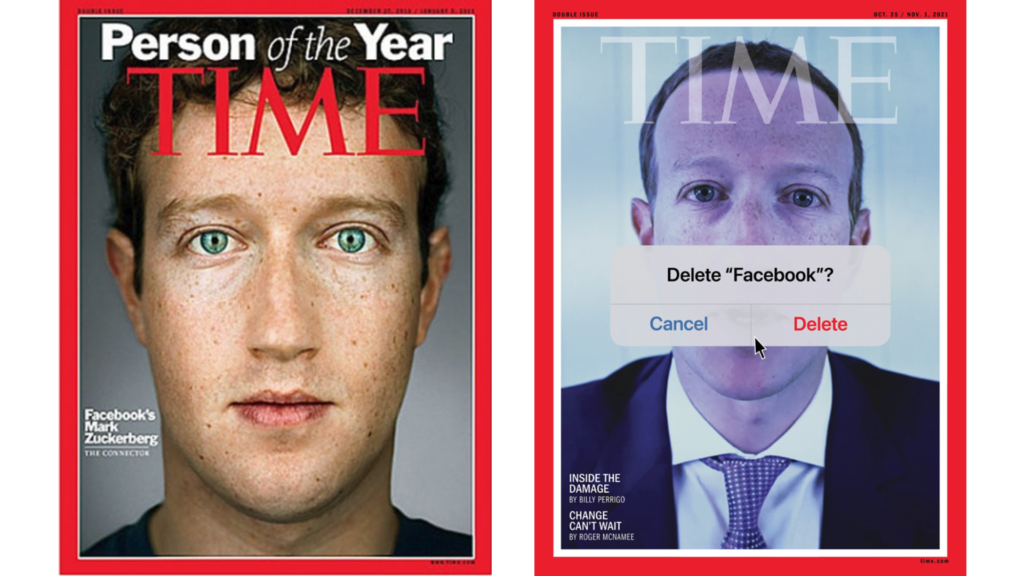
In its December 2010 issue, Time Magazine chose Mark Zuckerberg, founder and CEO of Facebook, as its Person of the Year. Lev Grossman wrote in the editorial piece:
“Facebook has merged with the social fabric of American life, and not just American but human life: nearly half of all Americans have a Facebook account, but 70% of Facebook users live outside the U.S. It’s a permanent fact of our global social reality. We have entered the Facebook age, and Mark Zuckerberg is the man who brought us here.”
A decade later, Zuckerberg appeared again on the cover of Time, but this time the tone was different. A “delete Facebook?” dialog box was superimposed on Mark Zuckerberg’s image. Roger McNamee, a former advisor to Zuckerberg, wrote in the piece accompanying the cover:
“It is clear that policymakers and the media have consistently underestimated the threat posed by Facebook, buying into the company’s rosy claims about the power of connecting the world…The sad truth is that the unregulated tech industry produces products that are unsafe…Based on the evidence of the past five years, one might say that Internet platforms have launched an attack against democracy and self-determination. It is a battle they will win unless voters and policymakers join forces to reassert their power.”
Within a single decade, optimism and admiration for the technology industry gave way to worry and fears for the future. Surveys show that the public is losing trust in technology companies. Meanwhile, they continue to amass wealth and power. The combined market value of the seven leading technology giants has grown 20-fold over the past 13 years. These companies are the architects of our social reality. They are designing it to suit their own agendas—knowingly or inadvertently creating and facilitating inequality, manipulation, censorship, surveillance, and conflict. We may not be living in a dystopian reality at present, but we are certainly moving towards one.
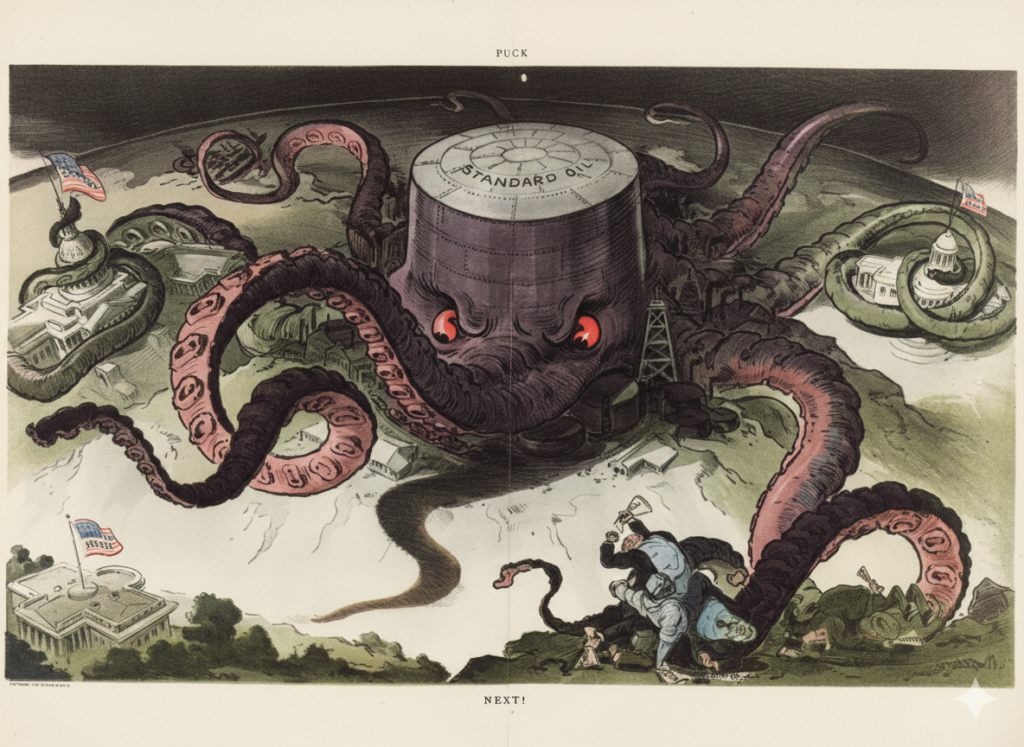
One approach to addressing the disproportionate power held by major technology monopolies, often advocated by left-leaning politicians, is to break up these corporations into smaller, independent companies. Breaking up technology giants would reduce their influence over markets, politics, and public discourse, foster competition, and encourage innovation. It would prevent any single company from dominating key sectors, controlling vast amounts of user data, or stifling smaller competitors, thereby creating a more balanced technological landscape. This is especially called for in light of the recent AI boom.
This may sound like a radical move, but there is historical precedent for breaking up large monopolies. In 1911, the U.S. government dismantled Standard Oil, which had dominated the oil industry and engaged in anti-competitive practices, splitting it into multiple smaller companies that eventually became Exxon, Mobil, Chevron, and others. In 1982, AT&T, which held a near-total monopoly over telephone service in the United States, was broken up into several regional companies to encourage competition in telecommunications. Even the most powerful corporations can be divided to restore competitive markets.
Current technology giants are larger and, in many ways, more powerful than Standard Oil or AT&T at their peaks. The AI boom is complicating things further. Forcing them to dramatically restructure would require regulators and politicians at the highest levels of the U.S. government to be highly motivated and committed to these measures. At present, the likelihood of that occurring seems low.
You have completed this series. Well done!
91 · 2 · Dec. 30, 2025 · Culture, Future, Markets · Index
Continue to this week’s featured note:
-

Magic Swords
Vikings, magic swords, and why technology should be as easy to understand as it is easy to use.